
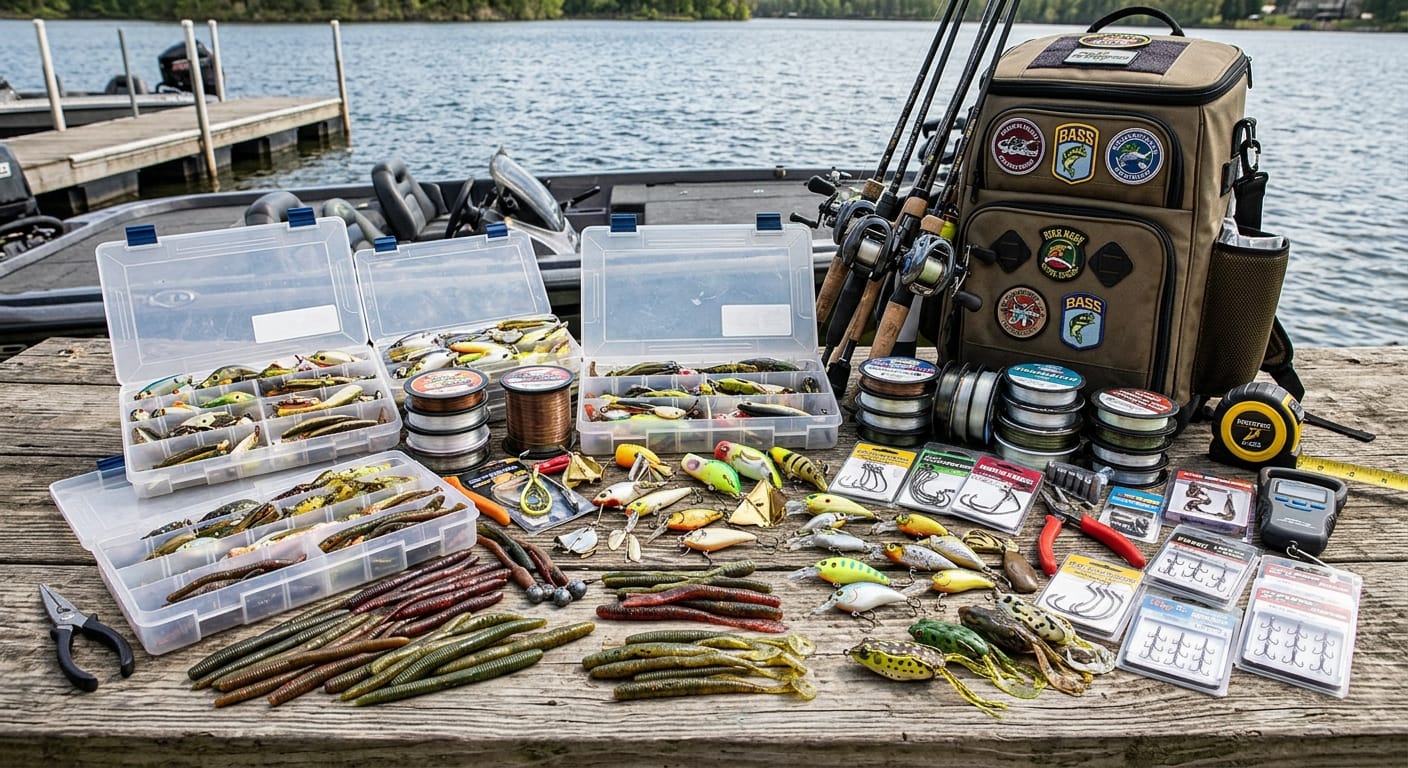
A first-year high school angler needs one reliable spinning and one baitcasting combo, monofilament and fluorocarbon line, a core terminal tackle kit with hooks, weights, and swivels, and four to six proven soft plastic styles in natural and reaction colors, covering most tournament situations without overloading your budget or your tackle bag.
Why does gear feel so overwhelming before the first practice?
The tackle industry markets to pros rather than to 16-year-olds on a part-time job budget, and that gap creates a lot of unnecessary panic.
Walk into any big box sporting goods store the week before your first high school tournament practice and the wall of rods alone will make you want to sit down. Every one of them has a different action rating, a different price point, and a tag that implies you need it for some specific technique you have never heard of. It is a lot, and none of it is organized around what a first-year team angler actually needs.
Here is the truth: the high school anglers who show up to the first practice with a clean, simple kit built around versatile gear almost always outperform the ones who showed up with a bag full of technique-specific rods they do not know how to use yet. Confidence in your equipment comes from familiarity, not from spending more money.
What rod and reel setup should a high school angler actually start with?
One mid-range spinning combo and one entry-level baitcasting combo will handle the majority of presentations a first-year tournament angler needs to throw.
You do not need eight rods. You need two that you can throw all day without fighting the equipment. For spinning, a 6’6″ to 7′ medium-light or medium rod paired with a 2500 or 3000 series reel covers finesse presentations, drop shots, shaky heads, and lighter jigheads. Brands like Ugly Stik, Shakespeare, and Lew’s all make reliable spinning combos in the $50 to $100 range that can genuinely last multiple seasons with basic maintenance.
For baitcasting, a 7′ medium-heavy with a reel in the 7.0:1 gear ratio range gives you the versatility to throw Texas rigs, swimbaits, and spinnerbaits. Entry-level baitcasters from Abu Garcia and Lew’s are worth the investment here over a bottom-shelf combo, mostly because a cheap baitcasting reel will backlash more and teach you frustration instead of technique. Budget $80 to $130 for that setup and it will serve you well into your second and third season.
If the budget only allows one rod to start, go spinning. The learning curve is shorter, the presentations are more forgiving, and a good spinning rod with a drop shot or shaky head will catch fish on nearly any body of water in the Southeast.
What line should a high school fishing team carry?
Monofilament and fluorocarbon cover the line needs of a first-year high school angler for almost every situation they will encounter.
Start with 8- to 10-pound monofilament on your spinning reel. It is forgiving, easy to manage, and visible enough that you can see line movement during finesse bites. Fluorocarbon in 10- to 15-pound test belongs on your baitcasting reel. It sinks, it is nearly invisible underwater, and it has the abrasion resistance you need when you are fishing around docks, rock, or any kind of heavy cover.
Braided line is worth knowing about but not a first priority. Once you are comfortable with your presentations and have a feel for your reel, adding a braid main line with a fluorocarbon leader on your spinning setup is a smart upgrade for finesse fishing in heavier vegetation. For a first season, keep it simple. Two line types, spooled correctly, beat five line types that you are not sure how to use.
Re-spool at least once a season, more often if you are fishing heavy cover or rocky bottom. Line is cheap compared to losing a tournament fish because of a frayed section you noticed and ignored.
What terminal tackle does a first-year team actually need to carry?
A core terminal tackle kit comes down to a handful of hook styles, a range of tungsten or lead weights, and a few swivels and snap rings.
Hooks first. Carry offset EWG (extra wide gap) worm hooks in 1/0, 2/0, and 3/0. Those three sizes will rig almost every soft plastic you pick up. Add a pack of shaky head jigheads in 1/8 oz and 3/16 oz, and a small pack of drop shot hooks in size 1 and 1/0. That is your hook selection for the first season.
Weights next. Bullet-style tungsten weights in 3/16 oz, 1/4 oz, and 3/8 oz handle the majority of Texas rig and punch bait situations. Tungsten is denser than lead, which means you get a smaller profile and better bottom feel for the same weight class. The cost difference over lead is real, but a few packs of tungsten will outlast lead in terms of durability and they are worth it even on a tight budget.
Round out the kit with a small pack of barrel swivels in size 7 or 8 and a few bobber stops for your Carolina rig. That is genuinely everything you need in a terminal tackle tray to be competitive your first season. Keep it organized so you can find what you need without dumping everything on the boat deck.
What soft plastics actually catch fish at the high school tournament level?
Four to six proven soft plastic styles in natural and reaction color palettes will cover the vast majority of situations a high school team will encounter.
Start with a 6-inch straight-tail or ribbon-tail worm. It is the most versatile soft plastic on the market and it catches bass everywhere. Green pumpkin and watermelon red are the two colors to build around. They work in clear to moderately stained water across the Southeast and they pair with every presentation from Texas rigs to shaky heads.
Add a 4-inch creature bait or chunk for flipping and punching. Craw-style plastics in green pumpkin or black and blue give you a natural profile that bass have been eating for decades. A 3.5 to 4-inch paddle tail swimbait in a shad or bluegill color rounds out the reaction side of your kit. Rig it on a shaky head or a weighted swimbait hook and you have a bait that covers open water, grass edges, and dock fishing.
If you want a fifth option, a stick bait like a Senko-style worm in green pumpkin or natural watermelon adds a wacky rig presentation to your rotation. The wacky rig is one of the most consistent tournament baits at every level of competition, and it is beginner-friendly enough that you can learn it in a single practice session.
Do not chase color trends. The anglers who burn money on every new colorway announced at trade shows are the same ones who show up underprepared on tournament morning. Lock in two to three core colors and learn them deeply.
Should a high school team build one shared kit or does every angler buy their own?
A shared team terminal tackle kit combined with individual rod-and-reel setups is the most practical and cost-effective structure for most high school fishing programs.
Rods and reels are personal. They get tuned to individual grip preferences, casting styles, and technique specialties over time. Each angler should own their own combos because a rod that lives in one person’s hands fishes better than a rod that gets passed around a boat.
Terminal tackle is a different story. Hooks, weights, and swivels are consumables. A team fund or parent booster budget that maintains a shared terminal tackle kit keeps everyone stocked without each angler spending $30 to $50 every few weeks on the same items. Assign one team member per season to manage restocking, and you will rarely show up short on the water.
Soft plastics fall somewhere in between. Each angler should have their own go-to bag, but buying a case of the same worm in three colors through a team order almost always gets you a better price per unit than individual retail. Check with your local tackle shop or a team-friendly online retailer about case pricing before the season starts.
The anglers who make noise in high school tournaments are rarely the ones with the most gear. They are the ones who know exactly what is in their bag, have confidence in every bait they pick up, and do not waste mental energy on equipment during competition. A clean, deliberate starter kit built around the categories above gets you there without the financial stress.
If you want to take the preparation side of tournament fishing just as seriously as the tackle side, Bite Blueprint delivers AI-powered tournament reports built for competitive anglers who want to show up with a real plan. It is the kind of information that turns a good tackle kit into a tournament-day advantage.
Common questions
Do high school tournament rules restrict the tackle you can use?
Most high school fishing organizations, including those affiliated with state bass federation programs, allow standard soft plastics, hard baits, and conventional terminal tackle with no major restrictions beyond live bait rules and hook count limits. Always read your specific league’s rulebook before the season starts, because rules vary by state and by tournament format. When in doubt, ask your coach or the tournament director directly.
Is it worth buying hard baits like crankbaits and spinnerbaits for a first season?
A spinnerbait in chartreuse-white and one in white, plus a medium-diving squarebill crankbait in a shad pattern, are the hard bait categories that earn a spot in a starter kit, but beyond those, your budget is better spent mastering soft plastics first. Technique depth on a few baits beats a tackle bag full of baits you have never practiced with.
What tackle bag or box setup works best for a high school tournament angler?
A medium-sized soft-sided tackle backpack with removable utility trays keeps your kit organized on a boat deck without taking up excessive space. Look for one with rod holders or rod straps on the exterior so you are not managing loose rods on tournament morning. Plano and Flambeau both make tournament-friendly options in the $40 to $70 range that hold up through a full season of competition.
How much should a high school angler realistically budget for a first-year tackle setup?
A complete first-year kit including two combos, line, terminal tackle, and a core soft plastic selection can be built for roughly $200 to $350 if you buy deliberately, which means resisting the impulse purchases at checkout and sticking to a list. Buying the right things once at that budget beats buying the wrong things twice at any budget.
One Comment